
What Exactly Are Google App Campaigns and Why Do They Matter for Your App’s Growth?

In the hyper-competitive mobile landscape, merely launching an app is no longer enough; visibility is paramount. For developers and marketers striving to cut through the noise and drive meaningful growth, the question isn’t if they should advertise, but how effectively. This is precisely where Google App Campaigns emerge as an indispensable cornerstone of any robust user acquisition strategy.
Defining Google App Campaigns: Your Automated Growth Engine
At their core, google app campaigns are Google’s powerful, machine learning-driven solution designed to simplify and optimize app promotion. Unlike traditional ad campaigns that demand meticulous manual setup across various channels, GACs streamline the entire process. You provide the app listing, bidding strategy, and a few creative assets, and Google’s advanced algorithms handle the heavy lifting, distributing your ads across its vast network.
This intelligent automation marks a significant evolution from their predecessors, the google universal app campaigns, often referred to as UAC campaigns. While UACs laid the groundwork for automated app promotion, the current iteration of Google App Campaigns has refined the machine learning models, offering more granular control and sophisticated optimization capabilities to meet diverse campaign goals.
Google App Campaigns are not just an advertising tool; they are a strategic partner in user acquisition, leveraging AI to find your ideal users.
The Expansive Reach: Where Your App Gets Discovered
One of the most compelling aspects of Google App Campaigns is their unparalleled reach. By consolidating your efforts into a single campaign type, your app gains exposure across Google’s most trafficked properties:
- Google Search: Ads appear prominently to users actively searching for apps related to yours.
- Google Play: Direct promotion within the app store, targeting users browsing for new applications.
- YouTube: Engaging video ads reach audiences consuming content relevant to your app’s niche.
- Google Display Network: Millions of websites and apps where your ads can capture attention.
- Discover: Personalized feeds that surface your app to users based on their interests and behavior.
This multi-channel distribution ensures your app is visible at critical touchpoints in a user’s journey, from initial curiosity to active search and engagement. This integrated approach maximizes the chances of connecting with high-intent users.
Why GACs Matter for App Growth in 2025
The mobile ad spend landscape is monumental, projected to reach $362 billion worldwide in 2023. In such a competitive environment, efficiency and intelligent targeting are non-negotiable. Google App Campaigns are not just a convenient option; they are a strategic imperative for several key reasons:
- Unmatched User Acquisition Scale: GACs tap into Google’s immense global audience, allowing you to scale your user acquisition efforts dramatically without proportionate increases in manual oversight.
- Machine Learning Driven Optimization: The core power of GACs lies in their reliance on Google’s sophisticated machine learning. These algorithms continuously analyze user behavior, ad performance, and conversion data to automatically adjust bids and ad placements in real-time. This ensures your budget is spent on users most likely to install and engage with your app.
- Focus on Value, Not Just Installs: Modern app growth isn’t solely about downloads; it’s about acquiring valuable users who perform in-app actions. GACs are designed to optimize for specific in-app events, whether it’s completing a tutorial, making a purchase, or subscribing to a service, aligning directly with your app’s business objectives.
In an era where every dollar counts, GACs provide a data-driven path to acquiring high-value users, transforming installs into tangible business outcomes.
By leveraging the deep insights from billions of user interactions, Google App Campaigns provide a dynamic, adaptive framework for reaching your target audience, making them an indispensable tool for any app looking to thrive in 2025 and beyond. Their evolution from basic UAC campaigns to a highly refined, AI-powered system underscores their critical role in modern mobile marketing.
How Can Robust Tracking with Firebase or MMPs Supercharge Your App Campaigns?
Imagine launching an app install campaign without a compass. That’s precisely what a google ads app campaign becomes without robust tracking. In the high-stakes world of mobile advertising, where global mobile ad spend was projected to reach $362 billion in 2023, every dollar counts, and every user action tells a story. Proper tracking isn’t just a best practice; it’s the foundational bedrock upon which all successful app campaign optimization is built.
Without precise data on installs and crucial in-app events, Google’s powerful machine learning algorithms operate blind. This leads to wasted ad spend, an inability to identify high-value users, and ultimately, a campaign that fails to deliver meaningful ROI. The difference between guessing and knowing is the difference between stagnation and hyper-growth.
Firebase vs. Mobile Measurement Partners: Your Tracking Arsenal
When it comes to tracking for your google ads app campaign, you essentially have two primary routes: Google’s own Firebase or a third-party Mobile Measurement Partner (MMP) like Adjust, AppsFlyer, or Branch. While both can provide the necessary data, Firebase offers distinct strategic advantages, especially when deeply integrated with Google’s ecosystem.
Firebase provides unparalleled synchronization with Google Ads. Unlike other MMPs that sync data via APIs, Firebase offers direct, real-time conversion syncing. This means Google Ads receives immediate, high-fidelity signals directly from your app, feeding its Smart Bidding algorithms with the freshest data possible. This tight integration is a game-changer for app campaign optimization, allowing for more responsive and accurate bid adjustments.
Beyond real-time data flow, Firebase unlocks critical capabilities such as audience exclusions. You can easily create audiences of existing users who have completed specific in-app actions, like a purchase, and exclude them from app install campaigns targeting new users. This prevents wasteful spending and improves user experience by not showing ads to those who have already converted or are highly engaged.
Furthermore, leveraging Firebase often grants you early access to beta features within the Google Ads platform. This strategic advantage allows you to experiment with cutting-edge tools and targeting options before they become widely available, potentially giving your app install campaigns a significant competitive edge.
Choosing Firebase or an MMP dictates the granularity and speed of your data.
Setting Up Essential In-App Events: The Core of Optimization
Regardless of your chosen platform, defining and tracking essential in-app events is non-negotiable. These events are the breadcrumbs that guide Google’s machine learning toward finding users most likely to achieve your campaign goals. The most fundamental events to track include:
first_open: This signifies a successful install and the user’s initial engagement. It’s the absolute minimum for anyapp install campaign.purchase: For e-commerce or subscription apps, tracking purchases (and their value) is critical for optimizing toward revenue generation.add_to_cart/begin_checkout: These pre-purchase events help understand the user journey and identify potential drop-off points.tutorial_complete: Essential for onboarding-heavy apps, indicating a user has understood the app’s core functionality.level_achieved: For gaming apps, this provides insight into player progression and engagement.
Each of these standard events provides crucial signals for app campaign optimization. They tell Google not just that an install happened, but what users do after installing, allowing the system to refine its targeting and bidding strategies more effectively.
Leveraging Custom Events for Deeper Insights
While standard events cover common user actions, your app likely has unique, high-value interactions that deserve attention. This is where custom events become indispensable. Custom events allow you to track virtually any specific action within your app, providing a nuanced understanding of user behavior. For instance, if your app is a meditation guide, you might track meditation_session_completed or guided_journey_started.
Custom events unlock granular optimization possibilities. They allow you to define what truly constitutes a valuable user beyond a simple install or purchase. By feeding these highly specific signals back into your google ads app campaign, you empower Smart Bidding to find users who engage with your app in ways that directly align with your business objectives. This level of detail transforms generic app install campaigns into highly targeted, performance-driven machines.
When defining custom events, ensure they are clearly named, consistently implemented, and directly tied to a measurable business outcome. This meticulous approach to tracking is what elevates a basic app install campaign to a strategically optimized growth engine.
What’s the Optimal Campaign Structure for Maximizing App Downloads and In-App Actions?
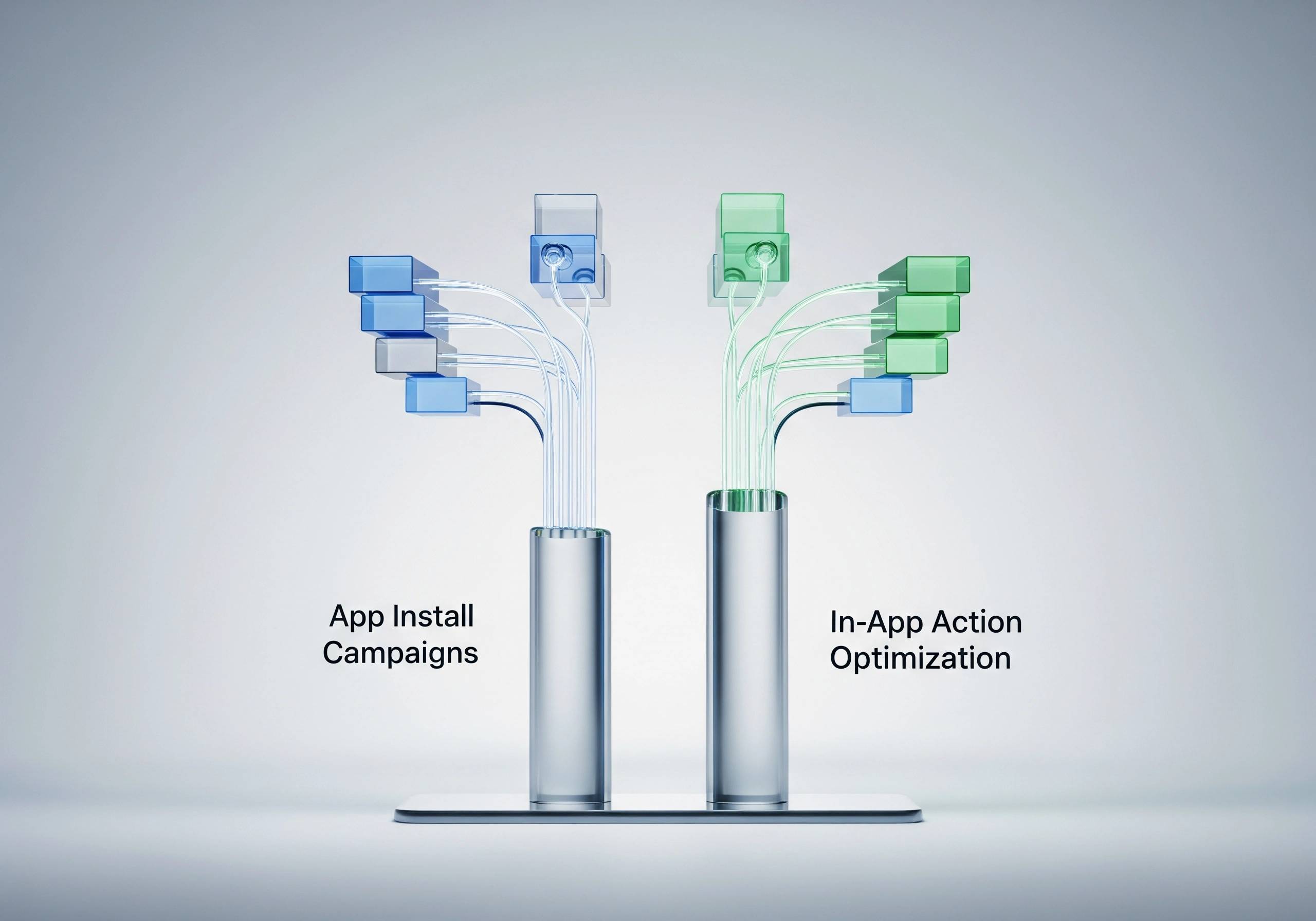
Navigating the intricate landscape of Google App Campaigns demands a strategic blueprint, especially when the goal is to drive both initial user acquisition and valuable in-app engagement. The foundation of success lies in structuring your campaigns in a way that allows Google’s powerful machine learning algorithms to learn efficiently and optimize for your specific objectives.
The Dual-Campaign Strategy: Installs vs. Actions
Google’s recommendations for optimal campaign structure often converge on a dual-campaign strategy per geographic region. This means running one dedicated campaign for app install campaigns and another for optimizing in-app actions. This segregation is not arbitrary; it recognizes the distinct phases of the user journey and the different data signals required for each.
Phase 1: Prioritizing App Installs
When you first launch a new app or target a new market, your primary objective is often volume—getting the app into as many hands as possible. This is where dedicated google ads for app installs campaigns shine. Start by focusing purely on installs as your conversion event.
Allowing the algorithm to learn through install data is paramount. Google’s machine learning needs a significant volume of data points to understand which users are most likely to convert. By concentrating on installs initially, you provide a clear, high-volume signal that accelerates this learning phase. This early data then becomes the bedrock for more sophisticated optimization later on.
A broad install campaign builds the necessary audience base. Without a substantial user base, optimizing for niche in-app actions can be an uphill battle. Think of install campaigns as the necessary first step in building your app’s ecosystem, allowing you to quickly scale your user acquisition efforts across Google’s vast network.
Phase 2: Optimizing for In-App Actions
Once your install campaigns have gained traction and Google’s algorithms have accumulated sufficient install data, it’s time to introduce campaigns optimized for specific in-app actions. These could range from completing a tutorial, making a purchase, subscribing to a service, or reaching a certain game level.
The shift from installs to actions represents a strategic evolution. You’re moving beyond mere acquisition to focus on user quality and lifetime value. These action-focused campaigns leverage the insights gained from your install campaigns, but fine-tune their targeting and bidding strategies to attract users who are not just installers, but engagers.
Crucially, these campaigns require robust tracking of in-app events. Whether through Firebase or a Mobile Measurement Partner (MMP), accurate event tracking allows Google to identify and target users exhibiting behaviors indicative of high value. This is where your investment in tracking truly pays off, transforming raw installs into tangible business outcomes.
Strategic Ad Group Segmentation
Within these install or action-focused campaigns, the strategic use of ad groups becomes your lever for testing and refinement. Ad groups allow you to segment your audience, creatives, and optimization signals, providing granular control over your campaign’s performance.
Ad groups are your experimental playgrounds. They enable you to A/B test different creative themes, messaging angles, or app features without disrupting the performance of your entire campaign. For instance, within an install campaign, you might have one ad group focused on the app’s utility features and another on its entertainment value, each with tailored ad copy and visuals.
Leveraging Ad Groups for Deeper Insights:
- Feature-Specific Messaging: Segment ad groups by distinct app features. For a productivity app, one ad group could highlight calendar integration, while another focuses on task management, each with unique ad creatives.
- Audience Nuances: While App Campaigns are largely automated, ad groups can still help structure how you approach different potential user segments, allowing you to test which creative appeals most to a perceived demographic, even if direct targeting isn’t available at the ad group level.
- Seasonal or Event-Based Promotions: Create temporary ad groups to promote specific in-app events, sales, or seasonal content, ensuring your messaging is timely and relevant.
Effective ad group segmentation empowers you to systematically test hypotheses. This iterative approach ensures you’re continually learning what resonates best with your target audience, leading to more efficient spend and higher conversion rates for both app installs google ads and valuable in-app actions.
By adopting this structured approach—starting with dedicated install campaigns, then layering in action-focused campaigns, and meticulously segmenting with ad groups—you provide Google’s AI with the clearest path to maximize your app’s growth potential.
Why Are Compelling Ad Creatives the Secret Weapon for App Campaign Success?
In the highly competitive mobile app landscape of 2025, where hundreds of thousands of apps vie for user attention, compelling ad creatives are not just an advantage—they are the secret weapon for app campaign success. Even the most sophisticated targeting and optimal campaign structure fall flat without visuals and messages that truly resonate. These creative assets are the first, and often only, impression your app makes on potential users.
The Dual Power of Creatives: Attracting Users & Fueling AI
High-quality, diverse creative assets serve a critical dual purpose within Google App Campaigns (GACs). Firstly, they grab user attention, communicate value, and drive initial interest. Secondly, and perhaps less obviously, they are the primary data feed for Google’s powerful machine learning algorithms.
Every image, video, and line of text you provide teaches the AI what works best for different audiences and placements. The more varied and effective your creative portfolio, the faster and smarter Google’s system can optimize your google app download campaigns.
Beyond the Click: How Creatives Persuade and Convert
Consider the sheer volume of digital content users scroll through daily. To cut through this noise, an ad creative must be instantly engaging. It needs to convey your app’s unique selling proposition (USP) within mere seconds, prompting users to stop, tap, and learn more.
This isn’t just about aesthetics; it’s about strategic communication. A well-designed creative anticipates user needs and showcases how your app provides a solution, entertainment, or utility. It bridges the gap between passive viewing and active engagement.
The Essential Creative Mix for GACs
Google App Campaigns thrive on a rich supply of assets. While the system automates ad creation, it’s the quality and diversity of your input that determines output effectiveness. Think of it as providing a master chef with the finest, most varied ingredients.
Text Assets: The Narrative Backbone
Don’t underestimate the power of well-crafted text. Headlines and descriptions provide context, highlight features, and articulate benefits that visuals alone might miss. They work in tandem with images and videos to form a cohesive message.
- Headlines (Up to 5): Short, punchy, benefit-driven. Experiment with different angles: problem/solution, feature highlights, urgency.
- Descriptions (Up to 5): Expand on headlines, adding more detail about what makes your app essential. Use strong calls-to-action.
Image Assets: Visualizing Value
Images are often the first element users perceive. They should be high-resolution, visually appealing, and directly relevant to your app’s core functionality or user experience. Static images are crucial for reaching users across the Google Display Network and other visual placements.
- Diversity in Themes: Show different aspects of your app—UI screenshots, lifestyle shots, value propositions.
- Varying Orientations: Provide both landscape and portrait images to fit different ad slots.
Video Assets: The Ultimate Engagement Driver
Video is arguably the most powerful creative format for google app promotion. It allows you to demonstrate your app in action, tell a story, and evoke emotion in a way that static assets cannot. Videos are particularly effective on YouTube and Discover feeds.
- Keep it Short: Aim for 15-30 seconds, capturing attention in the first 3-5 seconds.
- Show, Don’t Just Tell: Highlight key features, user interface, and the in-app experience.
- Sound Matters: Include engaging audio, music, and voiceovers where appropriate.
Video creatives often achieve significantly higher engagement rates, providing invaluable data for Google’s machine learning.
Crafting a Winning Creative Portfolio: Best Practices
Developing a robust creative strategy is an ongoing, iterative process. It requires continuous experimentation and data analysis, treating your creatives as living components of your UAC ads strategy.
1. Embrace Diversity in Themes and Formats
Provide a wide array of creatives that explore different angles, benefits, and emotional appeals. Don’t put all your eggs in one basket; a varied portfolio allows Google’s AI to test and learn which combinations resonate with specific user segments. This is key for global app campaigns.
2. Prioritize High Quality and Professionalism
Low-quality creatives reflect poorly on your app. Invest in professional design, high-resolution imagery, and polished video production. Crisp visuals and clear messaging build trust and perceived value.
3. Implement Rigorous A/B Testing
Never assume what will work best. Continuously test different headlines, descriptions, images, and video variants. Use performance data (installs, in-app events, CPA) to identify top-performing assets and inform future creative development.
4. Combat Creative Fatigue with Regular Refreshment
Even the best creatives eventually experience diminishing returns. Users become accustomed to seeing them, leading to lower engagement and higher costs. Plan to refresh a portion of your creative assets every 4-6 weeks to keep your campaigns fresh and effective.
5. Leverage Data for Iteration and Optimization
Your Mobile Measurement Partner (MMP) or Firebase data is invaluable here. Analyze which creatives drive not just installs, but also high-value in-app actions. Use these insights to double down on successful creative themes and retire underperforming ones.
By systematically developing, testing, and refreshing a diverse portfolio of compelling ad creatives, you equip Google’s machine learning with the necessary fuel to find and acquire your most valuable users consistently. This proactive approach transforms creatives from mere ad components into a strategic advantage, ensuring sustained success for your google app download campaigns.
How Can Smart Bidding and Budget Allocation Ensure Maximum ROI for Your App Campaigns?

Maximizing the return on investment (ROI) from your app campaigns isn’t just about driving installs; it’s about strategically managing your budget and leveraging advanced bidding mechanisms. In the dynamic world of Google App Campaigns, where machine learning dictates much of the optimization, mastering budget allocation and bidding strategies becomes a critical differentiator for app growth in 2025.
The Evolution of Bidding: From Manual Oversight to Intelligent Automation
Gone are the days when advertisers had to meticulously set manual bids for every keyword or placement. Modern Google Ads app campaign management thrives on Smart Bidding, a sophisticated suite of automated strategies powered by Google’s vast machine learning capabilities. This paradigm shift means your daily budget is no longer a static ceiling but a dynamic lever for algorithmic optimization.
Smart Bidding analyzes countless real-time signals—device, location, time of day, user behavior, and more—to predict the likelihood of a conversion. It then adjusts bids in the auction to achieve your campaign goals, whether that’s driving installs or specific in-app actions. This automation is designed to find the most valuable users within your budget.
Why Smart Bidding is Crucial for App Campaigns
For app campaign optimization, Smart Bidding offers unparalleled efficiency and scale. It allows advertisers to focus on strategic insights rather than granular bid adjustments, freeing up time to refine creatives or improve the in-app experience. This automation ensures your paid ads are always working towards the most impactful outcomes.
It continuously learns from performance data, adapting to market changes and user trends, something no human can do at scale. This intelligent system helps ensure your ad spend is always directed towards users most likely to convert.
Choosing Your Bidding Strategy: Aligning with App Goals
The right bidding strategy is the cornerstone of effective budget allocation. Your choice should directly reflect your primary campaign objective.
Target CPA (Cost Per Acquisition)
If your goal is to acquire new users at a specific cost, or to drive a particular in-app event (like registration or reaching a certain level), Target CPA is your go-to strategy. You set an average CPA you’d like to achieve, and Google’s system optimizes bids to get as many conversions as possible within that target.
- Ideal for: Campaigns focused on installs, free trials, or initial engagement actions. It prioritizes volume of conversions at a predictable cost.
Target ROAS (Return On Ad Spend)
For apps with clear monetization models—subscriptions, in-app purchases, or e-commerce—Target ROAS is invaluable. This strategy focuses on maximizing conversion value (revenue) while aiming for a specific return on your ad spend. You tell Google the desired percentage of return for every dollar spent.
- Ideal for: Campaigns centered around revenue-generating in-app events, ensuring that your ad spend directly contributes to profitability. This is essential for long-term app viability.
Maximize Conversions or Conversion Value
These strategies are often used when you’re less concerned about a specific CPA or ROAS target and more about getting as many conversions or as much conversion value as possible within your set daily budget. They can be particularly useful in the initial learning phase of a campaign or when testing new offers.
Aligning your bidding strategy with your app’s core business objective is non-negotiable for maximizing ROI.
Strategic Budget Allocation for Maximum Impact
Beyond selecting a bidding strategy, how you allocate your overall budget across different campaigns and ad groups is equally critical. Google App Campaigns are designed to spend your daily budget, but the efficiency of that spend is up to your strategic oversight.
The Daily Budget Dilemma
While Google aims to spend your daily budget, it can exceed it by up to 2x on any given day if it predicts a high likelihood of valuable conversions. This
What Advanced Strategies Can Elevate Your Google App Campaigns Beyond Basic Installs?
Moving beyond the initial thrill of app installs marks a pivotal shift for any serious app developer or marketer. While downloads are a foundational metric, they merely scratch the surface of an app’s true success. The real game-changer lies in cultivating engaged users who not only install your app but actively participate, convert, and become loyal advocates.
The Imperative Shift: From Installs to High-Value Outcomes
For too long, app install campaigns have focused on volume, treating every download as a victory. However, in the competitive landscape of 2025, an install without subsequent engagement is a hollow win. The goal has decisively pivoted: instead of merely acquiring users, the focus is now on acquiring valuable users who drive specific, measurable business outcomes.
This means shifting our mindset from chasing raw install numbers to diligently pursuing higher-value actions. Think purchases, subscriptions, trial sign-ups, feature adoption, or even reaching a specific level in a game. These are the true indicators of an app’s health and profitability.
True app success isn’t measured by how many download, but by how many engage and convert.
By optimizing for these deeper funnel events, we instruct Google’s sophisticated machine learning algorithms to find users who aren’t just curious, but genuinely interested in what your app offers and are likely to become revenue-generating assets.
Harnessing Custom In-App Events for Precision Optimization
To effectively chase these outcomes, standard install tracking is insufficient. The power lies in meticulously defining and tracking custom in-app events. These events provide granular data to Google’s Smart Bidding strategies, allowing for highly targeted app campaign optimization.
Consider a fitness app: instead of just tracking the install, you might track “workout started,” “premium subscription initiated,” or “meal plan viewed.” For an e-commerce app, events like “add to cart,” “checkout initiated,” or “purchase completed” are critical. Each custom event offers a clear signal of user intent and value.
Implementing these custom events, typically via Firebase or a Mobile Measurement Partner (MMP), allows Google’s AI to learn which users are most likely to complete these actions. This precision targeting moves your campaigns beyond generic reach to an audience primed for conversion.
Leveraging User Behavior Data for Hyper-Targeted Audiences
Beyond tracking specific conversion events, the rich tapestry of user behavior data provides an unparalleled opportunity for refined targeting. Analyzing how users interact with your app post-install can unlock segments that are ripe for further engagement or conversion.
For instance, you can identify users who frequently use a particular feature but haven’t yet subscribed, or those who have added items to their cart but abandoned it. This data allows for the creation of highly specific audience lists that can be targeted with tailored messaging within your google universal app campaigns.
This approach not only improves conversion rates but also enhances user experience by showing relevant ads. It’s about meeting users where they are in their journey and offering precisely what they need to move forward.
Understanding user behavior is the key to unlocking hidden conversion potential.
Advanced Firebase Features: Strategic Audience Exclusions
Quality over quantity is a recurring theme in advanced app campaign optimization. One powerful, yet often underutilized, strategy involves leveraging Firebase’s advanced audience features for strategic exclusions. While most campaigns focus on who to target, knowing who not to target can be equally impactful.
For example, if your primary campaign goal is new user acquisition for a premium subscription, you can exclude existing premium subscribers or even highly engaged free users who are unlikely to convert further from that specific campaign. This prevents wasted ad spend on users who have already achieved the desired outcome or are unlikely to do so through acquisition ads.
Similarly, you might exclude users who have been inactive for an extended period, allowing your budget to focus on more responsive segments. This refined approach ensures your advertising dollars are spent on the most promising prospects, significantly boosting campaign efficiency and return on ad spend (ROAS).
The Continuous Cycle of Testing, Refinement, and Expert Partnership
Elevating your app install campaigns beyond basic installs is not a one-time setup; it’s a continuous, iterative process. It demands constant A/B testing of creatives, bidding strategies, and audience segments. The app marketing landscape is dynamic, with user behaviors, competitive pressures, and platform algorithms constantly evolving. What works today might need adjustment tomorrow.
This level of sophisticated app campaign optimization requires deep expertise, specialized tools, and a commitment to data-driven decision-making. Navigating these complexities, from implementing advanced tracking to executing nuanced exclusion strategies, can be daunting.
For those seeking expert guidance in harnessing the full potential of Google App Campaigns and truly maximizing their app’s growth and ROI, digital marketing agency services for app marketing solutions from Digital Shift India can be invaluable. Digital Shift India helps businesses achieve measurable success by transforming their online presence into powerful revenue-generating assets, providing comprehensive digital marketing solutions tailored to their specific needs. Our expert team combines innovative strategies with in-depth analytics to ensure that every campaign is optimized for peak performance, enabling you to acquire high-quality users and achieve sustainable app growth. We focus on delivering not just installs, but valuable in-app actions that contribute directly to your bottom line, making us an ideal partner for app marketing success in 2025 and beyond. By partnering with Digital Shift, you gain access to cutting-edge tools and a dedicated team committed to turning your app’s potential into tangible results, allowing you to stay ahead in the competitive digital landscape. Partner with us today and elevate your app’s visibility, engagement, and profitability, simplifying the complexities of Google App Campaigns.
How to Overcome the Most Common Challenges in Google App Campaigns?

Even the most expertly structured and creatively rich Google App Campaigns can encounter unexpected hurdles. From sluggish install rates to frustrating ad disapprovals, these challenges can impede your app’s growth. The key to sustaining momentum in google app campaigns lies not in avoiding these issues, but in quickly diagnosing and resolving them with an iterative, data-driven approach.
Diagnosing and Boosting Low Install Volume
When your app isn’t attracting the downloads you anticipate, it’s a clear signal to investigate deeper. A common pitfall is an overly restrictive budget or an aggressive bid strategy that chokes off delivery. Google’s machine learning thrives on data; a campaign with too little budget might not gather enough to optimize effectively.
Low install volume often stems from insufficient budget or overly narrow targeting.
First, assess your budget. Is it adequate for your target CPA and market competition? Gradually increasing your daily budget can unlock more impressions and installs. Next, review your targeting: are you inadvertently excluding a large, relevant audience? Broadening geographic targets or demographics can expose your app to new potential users. Furthermore, refresh your ad creatives. Stale or unengaging visuals and copy can lead to low click-through rates, limiting your reach even with a healthy budget. Consider A/B testing new video assets or compelling headlines to reignite user interest.
A holistic review of budget, targeting, and creative freshness is crucial for increasing install velocity.
Addressing Poor Quality Installs and High CPA
Acquiring installs is only half the battle; acquiring quality installs is the true measure of success. If your campaigns are bringing in users who quickly churn or don’t engage with your app, or if your Cost Per Acquisition (CPA) is climbing, it’s time to refine your app campaign optimization strategy.
Poor quality installs and high CPAs often point to a mismatch between your ad message and the user’s expectation, or an optimization goal that’s too broad.
Begin by shifting your optimization focus. Instead of solely targeting installs, configure your campaign to optimize for a valuable in-app event, such as a registration, tutorial completion, or first purchase. This signals to Google’s AI the specific user behavior you value, guiding it to find similar, high-intent individuals. Review your ad creatives again. Do they accurately represent your app’s core functionality and value proposition? Misleading creatives can attract users who quickly realize the app isn’t what they expected. Finally, analyze your bid strategy. If using Target CPA, gradually lower it while monitoring performance to find the sweet spot between cost and volume. For very high CPAs, consider if your target in-app event is too difficult to achieve, or if you need to re-evaluate the lifetime value (LTV) of your users.
Optimizing for specific in-app actions and ensuring creative-user expectation alignment are vital for attracting high-value users at a sustainable CPA.
Resolving Ad Disapprovals and Tracking Discrepancies
Ad disapprovals can halt campaign progress, while tracking discrepancies undermine trust in your data. Both demand immediate attention and a systematic approach.
Ad disapprovals require strict adherence to policy, while tracking issues demand meticulous technical verification.
For ad disapprovals, the first step is to thoroughly read Google Ads policy guidelines. Google typically provides a reason for disapproval; address this specific concern directly. This might involve editing ad copy to remove prohibited phrases, replacing images that violate intellectual property rights, or ensuring your landing page (app store listing) is functional and safe. If you believe the disapproval was an error, appeal the decision with a clear explanation and supporting evidence. Proactive policy checks before launching new creatives can save significant time.
When confronted with tracking discrepancies—where Google Ads reported conversions don’t match your Firebase or MMP data—a technical deep dive is necessary. Verify that your Mobile Measurement Partner (MMP) or Firebase SDK is correctly implemented across all app versions. Check for consistent attribution windows between Google Ads and your MMP. Ensure that all critical in-app events are firing as expected and that any custom parameters (like revenue values) are being passed accurately. If the issue persists, don’t hesitate to leverage Google Ads support or your MMP’s technical team; they can often pinpoint complex integration issues.
Diligent policy review and robust SDK validation are non-negotiable for smooth campaign operation and accurate performance measurement.
Are You Ready to Transform Your App’s Growth in 2025?
The competitive landscape for mobile applications in 2025 demands more than just a presence; it requires a strategic, data-driven approach to growth. As mobile ad spend escalates, your ability to cut through the noise and attract high-value users hinges on mastering the intricacies of Google App Campaigns. This isn’t merely about launching ads; it’s about building a robust ecosystem designed for sustained performance.
The Pillars of App Growth in 2025
True success in google app campaigns begins with unwavering precision. Robust tracking, powered by solutions like Firebase or dedicated Mobile Measurement Partners (MMPs), provides the granular data essential for informed decisions. Without clear insights into installs and critical in-app events, your campaigns operate in the dark.
Data is the bedrock upon which all successful app marketing strategies are built.
Next, a meticulously crafted campaign structure ensures that every ad dollar works harder. Separating campaigns by objective—whether driving initial installs or optimizing for specific in-app actions—allows Google’s machine learning to bid more effectively. This targeted approach prevents wasted spend and directs resources to the most impactful user segments.
Compelling ad creatives are your app’s voice in a crowded digital space. High-quality text, engaging images, and persuasive video assets are not just aesthetic choices; they are critical data points that Google’s algorithms use to identify your ideal audience. Continuous A/B testing and creative refreshes keep your messaging fresh and relevant, adapting to evolving user preferences.
Smart Bidding strategies, such as Target CPA and Target ROAS, coupled with intelligent budget allocation, transform guesswork into calculated investment. These advanced mechanisms automatically adjust bids in real-time, ensuring you acquire users efficiently and maximize your return on ad spend (ROAS). This proactive financial management is a cornerstone of effective app marketing.
Embracing Continuous Optimization for a Competitive Edge
To truly transform your app’s growth, a commitment to continuous optimization is non-negotiable. The digital advertising landscape is fluid, with Google constantly updating its algorithms and privacy changes, like Apple’s ATT framework, reshaping data availability. This necessitates an iterative mindset: test, analyze, adapt, repeat.
Sustained growth comes from relentless refinement, not one-time setup.
Moving beyond basic installs to focus on deeper in-app engagement and customer lifetime value is where advanced digital marketing solutions truly shine. Leveraging custom events, advanced audience targeting, and strategic exclusions ensures you’re not just acquiring users, but retaining valuable ones. This future-proofs your strategy against market shifts and keeps you ahead of the curve in 2025.
Are you ready to elevate your app’s performance, moving from simply launching campaigns to orchestrating a sophisticated growth engine? The strategies outlined here provide a clear roadmap. For those seeking expert guidance and advanced implementation, partnering with specialists like Digital Shift can unlock the full potential of your google app campaigns, ensuring sustained success and maximum ROI. The time to act is now.
Ready to elevate your app’s performance? Discover how Digital Shift can craft and manage your Google App Campaigns for unparalleled growth and ROI.
Frequently Asked Questions about Google App Campaigns
What are Google App Campaigns (GACs) and how do they work?
Google App Campaigns (GACs) are Google’s AI-powered advertising solution designed to promote your mobile app. They automate ad creation and distribution across Google’s extensive network, including Search, Play, YouTube, and the Display Network, to drive app installs and in-app actions.
Why is robust tracking essential for Google App Campaigns?
Robust tracking, using tools like Firebase or Mobile Measurement Partners (MMPs), is crucial because it provides Google’s AI with precise data on user behavior and in-app events. This data fuels campaign optimization, allowing the system to identify and target users who are more likely to perform valuable actions, thereby improving campaign effectiveness and ROI.
What is the recommended campaign structure for Google App Campaigns?
An optimal structure often involves separating campaigns based on objectives: one for maximizing app installs and another for optimizing specific in-app events. This allows for more targeted bidding and budget allocation, ensuring you effectively acquire both new users and high-value, engaged users.
How do ad creatives impact the success of Google App Campaigns?
Compelling ad creatives are vital as they capture user attention and provide essential signals for Google’s AI. High-quality, diverse assets like images, videos, and text help attract the right audience and enable the machine learning algorithms to optimize ad delivery for better performance and conversion rates.
What are smart bidding strategies for app campaigns?
Smart bidding strategies, such as Target CPA (Cost Per Acquisition) and Target ROAS (Return On Ad Spend), automate bidding to achieve specific goals. These strategies leverage Google’s AI to optimize bids in real-time, aiming to maximize valuable conversions within your set targets and improve overall campaign efficiency.
How can I optimize Google App Campaigns for more than just installs?
To optimize beyond basic installs, focus on tracking custom in-app events that represent valuable user actions (e.g., purchases, registrations). Utilize this data to inform campaign bidding and targeting, and consider using audience exclusions to refine your reach and focus on users with higher conversion potential.